Mixed Agenda Couple:
One leaning in, the other leaning out
Latest Research estimates that 30 Percent of Couples Seeking Marriage Therapy are a “Mixed Agenda” and Seeking A Specific Kind Of Help
CLARITY, CONFIDENCE
& A Greater Understanding
The Leaning Out Spouse Emotional Stance

1. LIBERATION. Divorce as liberation. Are you thinking of getting out of a marriage that has held you back or holding you down, having freedom, getting unshackled, and thinking of having an affair? Are you thinking of living alone? Midlife crisis? You don’t feel under pressure to get out, but feel emotionally withdrawn from a relationship and imagine a different partner.
2. RELIEF. Divorce is a relief. You feel a kind of burden, picked on, put down, and emotionally beaten down, and want relief from that internal pressure to get out of the intolerable situation. Unlike the first one, you feel like you can’t stay where you are and have emotional equilibrium. You feel like you can’t take it anymore. This often involves more emotional volatility. You want something to happen quickly.
3. RELUCTANT. Divorce as reluctant letting go. You are not enamored with the freedom of a single life. You know there is no lack of stress in the divorce world. There is no intense pressure to do anything soon, though I have been thinking about divorce for some time. You don’t see a pathway to have a better marriage and family. You are reluctantly considering letting go of your marriage.
The Leaning In Spouse Emotional Stance

DESPERATE. You are in a panic, desperate to save the marriage. You are anxious to make it better. Maybe you just realized the dire situation you are in with your partner. Even if you have been thinking of or talking flippantly about divorce, something happens when your partner says they are going to leave you and puts divorce on the table. You feel panic. Even if you have thought of it yourself, the feeling of losing control yields an anxious, desperate emotional stance. Often, you make mistakes out of desperation: a. PURSUE. You might suddenly smother your spouse with actions of closeness: touch, affection, attention, and constantly checking in. This makes you appear unattractive to your partner. b. ANGRY. You are judgmental toward your partner. You call your partner out in front of the children and tell them how awful your partner is for trying to split up the family. You mock your partner at social gatherings or post negative, blaming things about them on social media.
2. FOCUSED. You have realized there is trouble in the marriage and have contributed to it. You are learning to be empathetic toward your spouse's pain. “I see the pain I have caused, or am open to seeing things with clarity.” You are focused on bringing your best self forward. This is a response to a “wake-up call.” You are upset, sad, and angry, but you focus on bringing your best self forward when facing these hard things.
3. CONFLICTED. You are on the fence. You flip back and forth between wanting to save your marriage and wanting out, based on how your partner treats you. Due to intense emotional reactions, you need to slow down and stop flipping back and forth.
————————————————————————————-
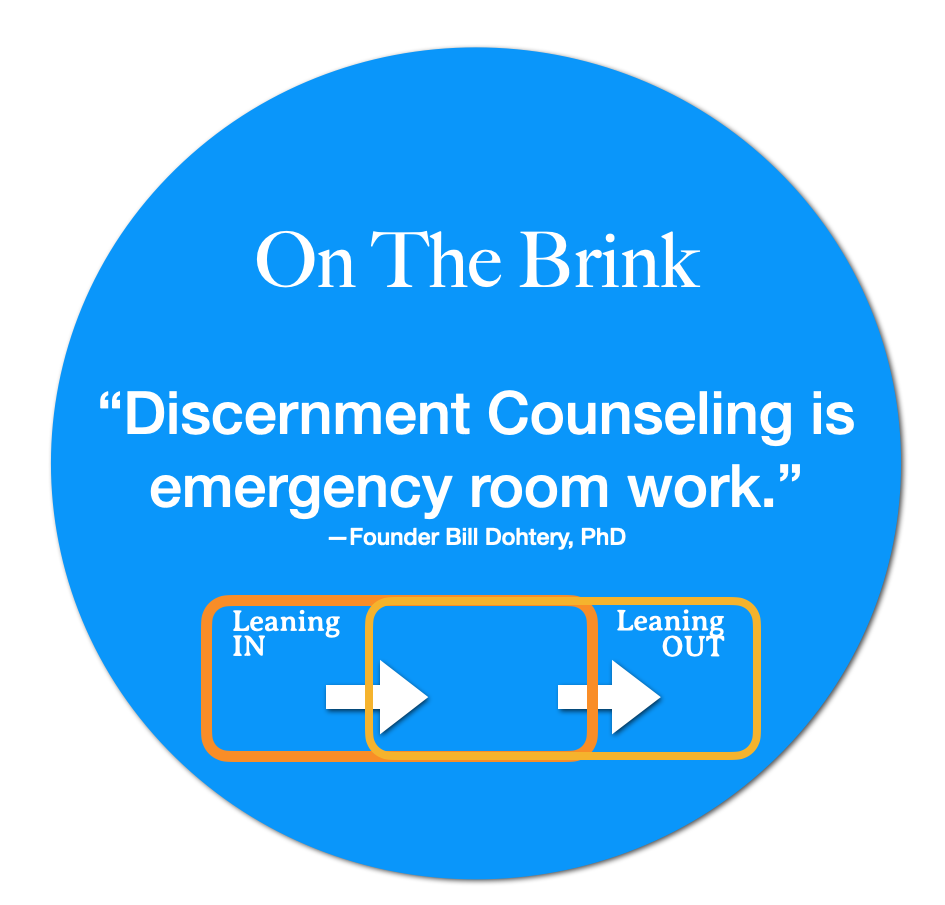
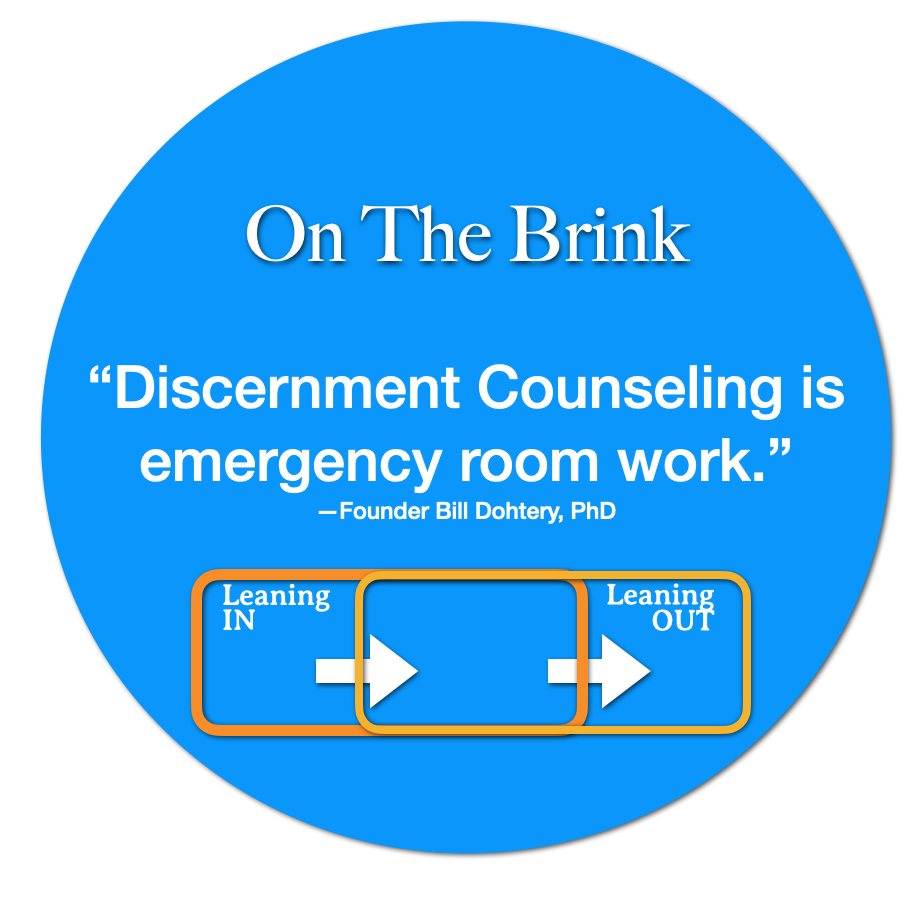
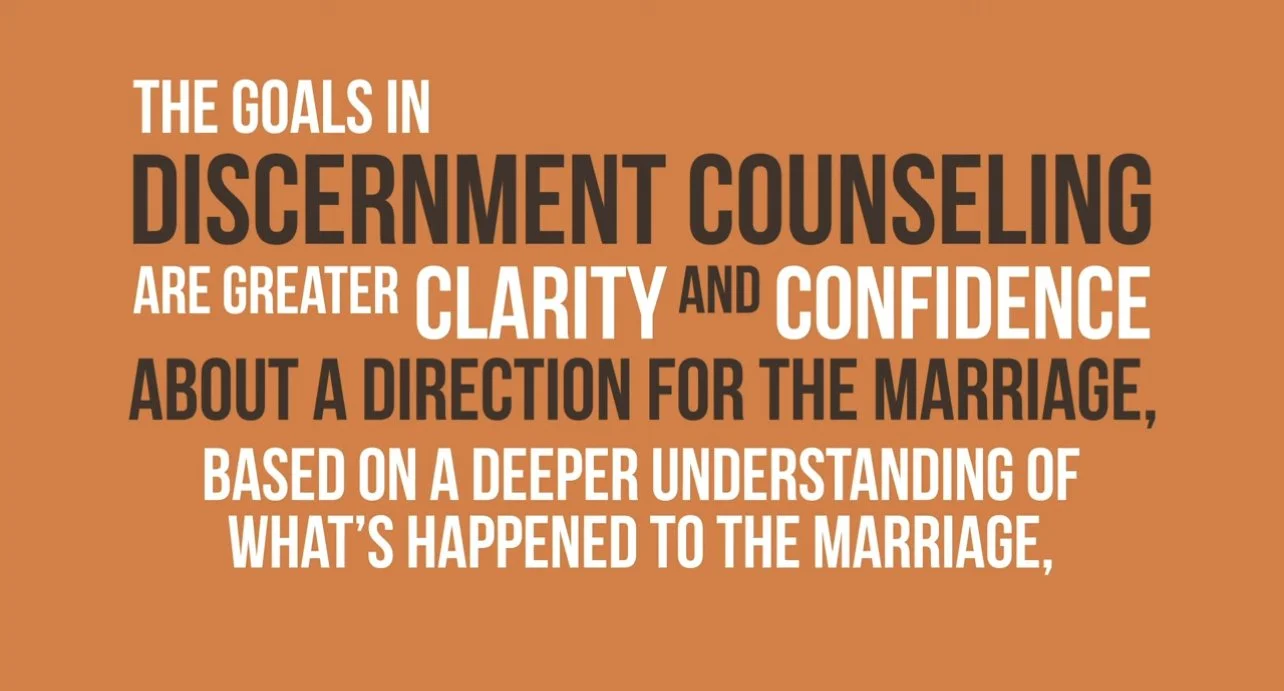
This type of counseling is “emergency room” work. Good, intense work is needed immediately, but in a different manner than the type of couple therapy where change is the focus. This is a crisis intervention. There needs to be a “readiness” for couples therapy. This is called “Discernment Counseling” to distinguish it from couple therapy, because mixed-agenda couples need particular focus on coming to CLARITY and CONFIDENCE about the direction of the relationship, based on a better understanding of what happened to the marriage and each person’s contribution to the problem. Not becoming closer and not trying to CHANGE, but ASSESS, step back, and turn inward.
Some couples may become ready for couples therapy; however, some will not. Discernment Counseling focuses on finding clarity so that informed, big decisions can be made for the best of each.
This gives the Leaning Out Spouse, often seen as the bad guy, the help they need: CLARITY and CONFIDENCE in their decision. It is a process in which the pressure of change is off, and the option of honesty and clarity becomes possible.
This gives the Leaning-in Spouse a place to focus and face the reality of the situation instead of desperately pursuing an already ambivalent partner.
Each partner gets a private space, individual sessions, and couple sessions to come to terms with how they feel and what they want to bring their best self forward and make a decision from CLARITY.
At the outcome of this process, the couple decides on one of three paths to go forward:

1. PATH ONE: STATUS QUO. This is where the couple chooses to stay in the relationship as it has been. A spouse isn’t eager to divorce but doesn’t have the energy and motivation for a total effort in therapy. a. The spouse may have softened, seen the relationship more complexly, and understood their role. b. Another situation is when a spouse is just paralyzed and anguished and can’t make a decision. NOTE: Path One is chosen after the discernment work is done. They hope to decide between Path Two and Path Three eventually, and you will move on to review what was learned. This is a way NOT TO FORCE A DECISION. There is no pressure to force anything from the therapy, just CLARITY and a DEEPER UNDERSTANDING. The current research shows that around 20% of couples chose Path One. This option can also prevent a partner from choosing a premature divorce, as well as being half-hearted and likely to fail couples therapy.
BILL DOHERTY WRITES: Path 1 (status quo) implicitly invites the leaning-out spouse to rule that out. The leaning-in spouse often rules out Path 1 as well, to the surprise of the partner who thinks their mate wants to stay together without change. The therapist, too, can support the idea that something has to change—the marriage cannot continue as it has been. Sometimes, the discernment process begins with agreement rather than disagreement—something has to change; the old way of marriage is no longer viable.
2. PATH TWO: SEPARATION and DIVORCE. This is where the couple decides to stop trying to change the relationship to make it better and instead works to reduce their resentment toward each other, tend to the business of separation and divorce, and end the marriage.
The framing option of Path 2 puts the divorce directly on the table where it has been for the leaning-out spouse, making this choice an acceptable part of the discernment counseling process and not a topic to be avoided because it’s so loaded for the leaning-in spouse—and also not threatening to the process of couples therapy because we are not doing couples therapy. Implicitly, we are saying that divorce is not a failure in this process; it is simply one option to be explored, even though only one spouse is actively considering it. Path 3 is a 6-month commitment to couples therapy (and sometimes other forms of help, such as substance abuse counseling, parenting classes, or individual therapy) with divorce off the table and with the possibility of putting divorce back on the table at the end of the six months.
3. PATH THREE: FOCUSED COUPLES THERAPY.
Compassion, Kindness & Mercy Turned Inward First, Then, Toward Your Partner
You are both going through a Self-Identity and a Relationship Identity Update. The leaning-out partner has real and important reasons. The leaning-in partner has real and important reasons. In this therapy, both are true simultaneously.
By focusing on your own patterns and the expectations that need updating, each person also recovers their own integrity, with your words and actions coming back into line. Long-term relationships are complex enough that you can become someone you don't even like. This therapy is about becoming the next version of yourself, someone you can enjoy being again.
This path involves a six-month commitment to couples therapy with divorce off the table during that time. Sometimes other resources are added, such as individual therapy or educational materials.
GIANT STEPS DON'T WORK—SMALL STEPS TAKEN OFTEN CAN
The structure is growth-oriented, with real-world small steps taken often. Each partner identifies three to five specific practices to work on outside the sessions (Click Here For Examples). These are concrete, observable actions rather than vague intentions. Weekly sessions include check-ins on what went well, what felt difficult, and what each person noticed about their own patterns.
The sessions draw on Gottman's research and emphasize step-by-step communication skills (Click Here). Goals are clear and measurable. You will also spend time understanding how you arrived at this crossroads and clarifying what matters most to each of you right now. (Click Here For A 40-minute audio that describes the research and the couple therapy model)
FOCUS ON THE POSITIVE STEPS TAKEN WITHOUT IGNORING THE UNPLEASANT
The guiding principle is straightforward: water the plant you want to grow. Problems get addressed, but the primary energy goes toward building what you want while also giving your partner feedback about the impact they have on you, without blaming and focusing on core needs. Emotional regulation, leaning to calm, taking time outs, and how to return productively to address upsets and hurts, and repairing the friendship that is the heart of any long-term relationship.
At the end of six months, you decide together. Your options include continuing with the status quo for a while without active therapy, committing to another six months of focused work, or moving toward separation or divorce.
REPEATING UNPRODUCTIVE EFFORTS BECOMES MORE EXHAUSTING THAN TRYING NEW ONES
There is a strong pull in any outdated relationship pattern toward repeating outdated expectations, assumptions, and behaviors that no longer work to bring closeness and friendship. Your brain evolved to save energy by relying on the familiar. The fact that you are struggling and your relationship is not working well enough for either of you means that each of your nervous systems is already in the process of updating to something that does work for you and your relationship. Your brains are already doing that, so the therapy will meet a process that is already in motion.
At some point, growing becomes less exhausting than continuing to meet exact expectations and behave in specific ways. The old patterns now require more energy than learning new ones.
This path works best with genuine effort from both partners, when each person is willing to look honestly at their own contribution to the difficulties and practice new behaviors consistently between sessions.
Clarity comes from understanding. Understanding leads to updated expectations and assumptions about your partner, yourself, and your relationship. When those updated expectations are expressed through daily behaviors, whatever the outcome, you will have more confidence in what you choose next. Just know that this time, when it feels like the rug has been pulled out from under you? That means a significant self-identity update is in progress, so the next version of you is more able, more capable of seeing more clearly, and feeling more confident, earned from your hard work, in what matters most in whatever comes next.
———————————
TWO RULE OUTS FOR DISCERMENT COUNSELING
Sometimes one or both individuals in a marriage on the brink really can't take a look in the mirror at anything they've done. The upside to Discernment Counseling is you neither have to doom their marriage nor pursue couples therapy with them. Take some time to watch this video and learn more.
Discernment Counseling can be a transformative tool for couples on the brink of divorce, but it's crucial to understand the rule outs for its effectiveness. Bill Dougherty, co-founder of the Dougherty Relationship Institute, sheds light on why Discernment Counseling may not be suitable for every situation.
Relationship Counseling
In the realm of relationship counseling, Discernment Counseling stands out as a vital intervention for couples teetering on the edge of divorce. Spearheading this discussion is Bill Dougherty, co-founder of the esteemed Dougherty Relationship Institute. In his insightful discourse, Dougherty delves into the critical aspect of rule outs within Discernment Counseling, shedding light on why this approach might not be suitable for all couples.
Discernment Counseling
As Dougherty elucidates, operates akin to emergency room work, aimed at couples grappling with the weighty decision of whether to salvage their marriage or part ways. However, despite its transformative potential, Discernment Counseling isn't a one-size-fits-all solution. Dougherty emphasizes the importance of discerning when to rule out certain cases from this intervention.
Rule out 1:
One primary rule out scenario, as Dougherty outlines, involves cases where the leaning-out partner has unequivocally made up their mind about divorce, lacking any semblance of ambivalence. In such instances, where one partner is resolutely committed to ending the relationship, Discernment Counseling may prove futile. Dougherty underscores the injustice of subjecting the leaning-in partner to a process that falsely raises hopes of reconciliation when the decision has essentially been made.
Rule out 2:
Moreover, Dougherty highlights another pivotal rule out criterion: cases where the leaning-out partner harbors uncertainties about the marriage but remains open to reconciliation efforts. In such scenarios, where there's a genuine willingness to engage in couples therapy and explore avenues for reconciliation, Discernment Counseling might not be the most appropriate starting point. Instead, Dougherty suggests initiating couples therapy directly, capitalizing on the leaning-out partner's willingness to give the relationship another chance.
It's evident from Dougherty's insights that Discernment Counseling isn't a universally applicable remedy. Rather, it's a selectively powerful tool tailored to specific circumstances.
In conclusion, Dougherty's elucidation of rule outs in Discernment Counseling provides valuable insights for therapists and couples alike. By understanding the nuances of when to employ this intervention, practitioners can better support couples in navigating the complexities of their relationships, fostering informed decisions and meaningful transformations.

If PATH THREE is chosen, each person constructs a WRITTEN PLAN OF NEW BEHAVIOR to practice in the relationship for those six months.
Making short-term decisions can reduce some of the urgency and open more emotional and mental space inside each person for clarity and a path forward.
The idea behind Path 3 is to move beyond ambivalence about working on change and see whether it’s possible to put the marriage into a place that would be good for both partners. Path 3, as we emphasize repeatedly, involves each partner developing a personal agenda for change based on a deeper understanding of what has happened to the marriage and his or her role in the problems. We create severe expectations for the Path 3 decision; it can’t just be an aspiration to try therapy.
The framing option of Path 3 addresses the dilemma facing many leaning-out spouses: They feel pressured by their spouse (and maybe by others) to turn away from divorce and recommit to the marriage (long-term committed relationship), something they think they cannot do in their current state of demoralization and doubt. Sometimes, it has taken years to build up the courage to put divorce on the table in a chronically distressed marriage.
Path 3 avoids the “in or out” problem by offering a provisional commitment to work hard on the relationship for a period, with divorce not an option for this period but something that can be revisited later if things do not change enough. Thus, the discernment work for the leaning-out spouse is whether to embrace Path 3 and embark on couples therapy or continue the current divorce trajectory. In contrast, the discernment work for the leaning-in spouses focuses not on which path to choose (they are almost always in favor of Path 3) but on how to manage themselves during this challenging time to maximize the likelihood that their partner will choose Path 3 and work with them to restore the marriage.
Doherty, William J.; Harris, Steven M M. Helping Couples on the Brink of Divorce (Discernment Counseling for Troubled Relationships) (p. 15). American Psychological Association. Kindle Edition.
Doherty, William J.; Harris, Steven M M. Helping Couples on the Brink of Divorce (Discernment Counseling for Troubled Relationships) (pp. 15-16). American Psychological Association. Kindle Edition.
——————————-BRIEF SUMMARY OF DISCERNMENT COUNSELING SESSIONS
Discernment counseling, developed by Dr. Bill Doherty, is a specialized form for couples uncertain about their relationship's future. It's beneficial when one partner favors divorce while the other wants to save the marriage. Here are the key features:
Purpose:
Clarify Decision: The main goal is to help couples gain clarity and confidence about their relationship's next steps, whether attempting to reconcile or proceeding with a separation.
Non-Biased: It is not intended to save the marriage at all costs but to help couples decide on the most appropriate path forward.
Process:
Time-Limited: Typically consists of 1-5 sessions, each lasting 1-2 hours.
Separate and Joint Sessions include individual and joint sessions with each partner. This helps to understand each partner's perspective and feelings without bias.
Steps:
Initial Session: This session focuses on understanding each partner's perspective, the history of the relationship, and the issues at hand.
Individual Sessions: Each partner meets separately with the counselor to explore their thoughts, feelings, and motivations.
Final Joint Session: The counselor helps the couple discuss their insights and decide their relationship's future.
Possible Outcomes:
Stay Married and Work on Issues: Both partners agree to work on the marriage and possibly continue with traditional marriage counseling.
Move Toward Divorce: Both partners agree that separation is the best option.
Status Quo: Decide to maintain the current situation for a set period to gather more information and clarity.
Principles:
Respect for Both Partners: The counselor respects each partner's perspective and does not push for any specific outcome.
Focus on Clarity: The goal is to gain clarity and make an informed decision rather than immediate action.
Discernment counseling provides a structured, safe space for couples to discuss their relationships honestly and make thoughtful decisions about their future.